2026 Random NFL Stuff Thread…

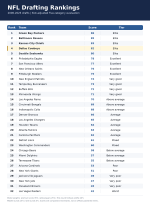
Interesting exercise: I asked ChatGPT to come up with a criteria for evaluating NFL drafting success, making it weighted on different factors, so we're not just talking about who got the most pro bowl selections, who got the most starts out of picks, etc, and then to rank the top 5 and bottom 5 drafting teams of the past 20 years. Here is what it gave me....

The window and the basic problem

I would evaluate the 20 drafts from 2006 through 2025, but I would not pretend every class is equally settled:


  • 2006–2021: full weight.
  • 2022: 85%.
  • 2023: 65%.
  • 2024: 40%.
  • 2025: 20%.

That keeps recent success from being ignored without declaring a one-year contributor a proven hit. A current 20-year analysis using player value over expectation similarly tapers the four newest classes because careers have not had equal time to develop.


The central question is not, “How many good players did the team draft?” It is:


How much NFL value did the team obtain compared with what should reasonably have been expected from the exact picks it possessed?


That matters because Baltimore picking 25th every year cannot be judged by the same raw-output standard as Cleveland repeatedly picking in the top ten.


My proposed Drafting Quality Index​


I would give each team a composite score built from five components.


1. Premium-pick performance: 35%​


This covers picks 1–100, but with declining importance:


  • Picks 1–10: maximum weight
  • Picks 11–32: 85%
  • Round 2: 65%
  • Round 3: 50%

For every selection, calculate:


actual career value − expected career value for that exact draft slot


A No. 4 pick who becomes a solid eight-year starter may be useful but still slightly disappointing. A player of identical quality taken 75th is an outstanding selection.


The expected-value curve is steepest near the top: one recent model estimates approximately 47.4 units of expected career value at pick No. 1, 31.7 at No. 32, 14.9 at No. 100 and only 6.4 at No. 200.


This receives the largest weight because missing on a top-ten pick costs much more than missing on pick 224. It represents both a lost opportunity to acquire a premium player and the forfeiture of unusually valuable draft capital.


2. Elite-player generation: 25%​


Teams should receive substantial additional credit for drafting genuinely difference-making players:


  • Hall of Fame or realistic Hall of Fame trajectory
  • First-team All-Pro
  • Sustained top-tier performance
  • Franchise quarterback
  • Multi-year Pro Bowl or equivalent high-level starter

This is necessary because an average-surplus formula can sometimes prefer a collection of mildly positive late-round picks over one transformational selection. But Patrick Mahomes, Lamar Jackson, Micah Parsons or Aaron Donald changes a franchise far more than several quality special-teamers.


The underlying player-value measurement should combine:


  • Weighted Approximate Value
  • Years and games as a starter
  • All-Pro selections
  • Peak performance
  • Longevity
  • Positional context

AV alone is imperfect and can reward mere accumulation, so awards and peak performance have to supplement it.


3. First-round hit and bust profile: 20%​


This component explicitly measures whether the team handles its most consequential decisions properly.


A first-rounder would be classified approximately as:


  • Major hit: elite player or long-term high-end starter
  • Hit: reliable multiyear starter worthy of the selection range
  • Marginal: contributor but below reasonable slot expectation
  • Bust: little meaningful value, especially before completing the rookie contract

Busts in the top ten get the largest penalty. Rest-of-first-round misses still matter, but not equally.


This is separate from total surplus because repeated first-round competence should count even when a team does not uncover a Hall of Famer. Green Bay, Baltimore and Dallas have generally been good at coming away with real starters when they spend first-round capital.


Historical results demonstrate how difficult premium drafting actually is. From 2006–2020, approximately 14% of top-ten picks reached “star” level, while 28.7% were classified as busts. The rest of the first round had a lower star rate and a 35.5% bust rate.


4. Middle-round roster building: 15%​


This covers rounds 2–5 and asks whether a team repeatedly produces:


  • Starting offensive linemen
  • Starting defensive backs
  • No. 2 receivers
  • Rotational defensive linemen
  • Starting linebackers
  • Useful tight ends and running backs
  • Players earning meaningful second contracts

This is where a scouting organization demonstrates repeatability. One fifth-round superstar might involve tremendous evaluation, but it also contains substantial luck. Producing two or three useful players in rounds 2–5 almost every year is a more sustainable organizational skill.


5. Late-round success: 5%​


Rounds 6–7 should count, but modestly.


Credit should depend on outcome:


  • Franchise player or star: substantial surplus credit
  • Multiyear starter: strong credit
  • Useful backup or core special-teamer: small positive credit
  • Brief roster appearance: essentially neutral
  • Never becomes a contributor: little penalty, because that is the normal result

This addresses your point exactly: consistently finding NFL players in the seventh round is evidence of good scouting, but it cannot outweigh repeatedly blowing first-round picks.


The historical bust rate for rounds 6–7 is roughly 93%, so simply failing to find a player there should barely count against a team.


What I would not include​


I would not directly use:


  • Team wins or championships
  • Free-agent acquisitions
  • Undrafted free agents
  • Whether the player remained with the drafting team for his entire career
  • Subjective post-draft grades
  • Production from picks acquired by trading a drafted player years later

A team deserves scouting credit for identifying and selecting a player even if it later mishandles his contract. Coaching and player development cannot be completely separated from drafting, but team success itself would introduce too many unrelated variables.


I would attribute the pick to the team that actually selected the player, not the club originally owning the selection.


Best drafting teams, 2006–2025​


1. Green Bay Packers​


Green Bay is my best overall drafting organization because its record is the most complete rather than being dependent on one short golden period.


Important hits include:


  • Greg Jennings, Round 2
  • Jordy Nelson, Round 2
  • Josh Sitton, Round 4
  • T.J. Lang, Round 4
  • Clay Matthews, late Round 1
  • Randall Cobb, Round 2
  • David Bakhtiari, Round 4
  • Davante Adams, Round 2
  • Corey Linsley, Round 5
  • Kenny Clark, late Round 1
  • Aaron Jones, Round 5
  • Jaire Alexander, Round 1
  • Rashan Gary, Round 1
  • Elgton Jenkins, Round 2
  • Jordan Love, late Round 1

Green Bay has been particularly exceptional on the offensive line. A current slot-adjusted analysis rates the Packers first in overall offensive drafting and best in offensive-line value over expectation; it also rates them first in rounds 4–5.


There have been serious misses—Justin Harrell, Derek Sherrod, Datone Jones and others—but the Packers repeatedly:


  1. Hit on late first-rounders.
  2. Produce starters in rounds 2–5.
  3. Find premium offensive players without premium draft positions.
  4. Successfully identify and develop quarterbacks.

That combination puts them slightly ahead of Baltimore.


2. Baltimore Ravens​


Baltimore might be No. 1 under a model giving even more weight to elite players and premium-pick reliability.


Major selections include:


  • Haloti Ngata, No. 12
  • Marshal Yanda, Round 3
  • Joe Flacco, mid-Round 1
  • Ray Rice, Round 2
  • Torrey Smith, Round 2
  • C.J. Mosley, mid-Round 1
  • Ronnie Stanley, No. 6
  • Marlon Humphrey, mid-Round 1
  • Lamar Jackson, No. 32
  • Mark Andrews, Round 3
  • Orlando Brown Jr., Round 3
  • Patrick Queen, late Round 1
  • Justin Madubuike, Round 3
  • Kyle Hamilton, mid-Round 1
  • Tyler Linderbaum, late Round 1
  • Zay Flowers, late Round 1

An earlier slot-adjusted AV study covering 2000–2020 ranked Baltimore first in the league, powered particularly by Yanda and Jackson.


The Ravens’ advantages are:


  • Very few catastrophic early-round mistakes.
  • Excellent results near the end of Round 1.
  • Strong offensive-line and defensive-back evaluation.
  • Several stars found on Day 2.
  • Lamar at No. 32, one of the greatest combinations of premium impact and selection value in the period.

Their curious weakness has been off-ball linebacker value in one current positional model, but the complete portfolio remains outstanding.


3. Kansas City Chiefs​


Kansas City’s ranking is not merely “they drafted Mahomes.”


The portfolio includes:


  • Brandon Flowers, Round 2
  • Jamaal Charles, Round 3
  • Eric Berry, No. 5
  • Justin Houston, Round 3
  • Dontari Poe, Round 1
  • Travis Kelce, Round 3
  • Dee Ford, late Round 1
  • Marcus Peters, late Round 1
  • Chris Jones, Round 2
  • Tyreek Hill, Round 5
  • Patrick Mahomes, No. 10
  • Juan Thornhill, Round 2
  • Creed Humphrey, Round 2
  • Trey Smith, Round 6
  • Nick Bolton, Round 2
  • Trent McDuffie, late Round 1
  • George Karlaftis, late Round 1
  • Isiah Pacheco, Round 7
  • Rashee Rice, Round 2

They have done virtually everything a drafting team can do:


  • Landed an all-time quarterback without picking first.
  • Found a Hall of Fame-level tight end in Round 3.
  • Found elite speed and production in Round 5.
  • Built offensive lines in rounds 2 and 6.
  • Regularly converted late-first-round selections into starters.

Kansas City ranks first in current slot-adjusted Round 2 performance, an especially meaningful category because the second round still contains legitimate star potential but comes with a bust rate above 50%.


The pre-Reid portion was less consistent, keeping the Chiefs below Green Bay and Baltimore, but the high-end return is extraordinary.


4. Dallas Cowboys​


Dallas is probably the NFL’s most underappreciated drafting organization because its postseason failures obscure how much talent it has selected.


Major hits:


  • Anthony Spencer, late Round 1
  • Mike Jenkins, late Round 1
  • Sean Lee, Round 2
  • Dez Bryant, late Round 1
  • Tyron Smith, No. 9
  • DeMarco Murray, Round 3
  • Travis Frederick, late Round 1
  • Zack Martin, mid-Round 1
  • DeMarcus Lawrence, Round 2
  • Byron Jones, late Round 1
  • Dak Prescott, Round 4
  • Ezekiel Elliott, No. 4
  • Jaylon Smith, Round 2
  • Michael Gallup, Round 3
  • Tony Pollard, Round 4
  • CeeDee Lamb, mid-Round 1
  • Trevon Diggs, Round 2
  • Micah Parsons, No. 12
  • Tyler Smith, late Round 1
  • DaRon Bland, Round 5
  • Jake Ferguson, Round 4

Dallas’s premium-round batting average is the major argument:


  • Tyron Smith
  • Frederick
  • Martin
  • Byron Jones
  • Elliott
  • Lamb
  • Parsons
  • Tyler Smith

Even several supposedly controversial first-round decisions became high-level players. Dallas also found a franchise quarterback in Round 4 and an All-Pro corner in Round 5.


A current positional model places Dallas fourth in offensive drafting, while older AV-surplus research also had the Cowboys comfortably above average.


Taco Charlton and Morris Claiborne were consequential misses, and some recent defensive selections remain unresolved. Nevertheless, Dallas has been remarkably good at converting first- and second-day capital into actual NFL starters.


5. Seattle Seahawks​


Seattle gets the fifth spot, narrowly over New Orleans and Pittsburgh, because its peak produced one of the greatest clusters of surplus draft value in modern NFL history.


The foundational run:


  • Russell Okung, Round 1
  • Earl Thomas, Round 1
  • Golden Tate, Round 2
  • Kam Chancellor, Round 5
  • K.J. Wright, Round 4
  • Richard Sherman, Round 5
  • Bobby Wagner, Round 2
  • Russell Wilson, Round 3
  • Bruce Irvin, mid-Round 1
  • Tyler Lockett, Round 3
  • Frank Clark, Round 2
  • D.K. Metcalf, Round 2

More recently:


  • Riq Woolen, Round 5
  • Charles Cross, Round 1
  • Devon Witherspoon, No. 5
  • Jaxon Smith-Njigba, Round 1
  • Boye Mafe, Round 2

The 2010–2012 classes essentially built a championship roster through the draft. A current 20-year analysis identifies Seattle as the best overall return-on-investment drafting team and the best defensive-back drafting team. It rates Seattle’s 2011 and 2012 classes as the best classes in the league in those respective years.


Why only fifth? The drafts from roughly 2013 through 2020 were far less dependable, particularly along the offensive line and in the first round. Seattle had an astonishing peak, whereas Green Bay and Baltimore were more consistent across the whole period.


Just outside the top five​


New Orleans: The 2006 and 2017 classes were magnificent, with Jahri Evans, Marques Colston, Cameron Jordan, Terron Armstead, Michael Thomas, Marshon Lattimore, Ryan Ramczyk, Alvin Kamara and Trey Hendrickson. New Orleans rates exceptionally well at receiver, defensive end and in Round 3. The Marcus Davenport/Peyton Turner era and several thin classes keep the Saints sixth for me.


Pittsburgh: Very strong long-term results with Lawrence Timmons, LaMarr Woodley, Antonio Brown, Cameron Heyward, David DeCastro, Le’Veon Bell, Stephon Tuitt, T.J. Watt, Alex Highsmith and George Pickens. Wide-receiver scouting is famous, though recent first-round and secondary results have been uneven.


Philadelphia: Fletcher Cox, Lane Johnson, Zach Ertz, Jordan Mailata, Dallas Goedert, Josh Sweat, Jalen Hurts, DeVonta Smith, Landon Dickerson, Jalen Carter and Cooper DeJean. Jason Kelce was a 2011 sixth-round masterpiece. Philadelphia’s weaker mid-2010s stretch keeps it outside the five, but its current trajectory is upward.


Worst drafting teams, 2006–2025​


1. Las Vegas/Oakland Raiders​


This is the clearest result.


Premium misses include:


  • JaMarcus Russell, No. 1
  • Darrius Heyward-Bey, No. 7
  • Rolando McClain, No. 8
  • D.J. Hayden, No. 12
  • Gareon Conley, No. 24
  • Clelin Ferrell, No. 4
  • Johnathan Abram, No. 27
  • Damon Arnette, No. 19
  • Alex Leatherwood, No. 17
  • Henry Ruggs, No. 12, whose career ended after a fatal criminal incident

There were genuine hits:


  • Khalil Mack
  • Amari Cooper
  • Derek Carr
  • Gabe Jackson
  • Maxx Crosby
  • Kolton Miller
  • Brock Bowers, provisionally

But the number and severity of first-round errors are overwhelming. One current 20-year analysis rates the Raiders worst in defensive-back drafting and worst among late first-round selections. An earlier AV-surplus study ranked them 31st, ahead of only Cleveland, and identified Russell as their largest negative.


The Raiders did not merely fail to find enough late-round gems. They repeatedly spent premium capital on players who produced almost nothing.


2. Cleveland Browns​


Cleveland has more excellent selections than its reputation suggests:


  • Joe Thomas
  • Alex Mack
  • Joel Bitonio
  • Myles Garrett
  • Denzel Ward
  • Nick Chubb
  • Baker Mayfield, at least a legitimate NFL quarterback
  • Jeremiah Owusu-Koramoah

But the failed premium picks are staggering:


  • Brady Quinn
  • Brandon Weeden
  • Trent Richardson
  • Justin Gilbert
  • Johnny Manziel
  • Barkevious Mingo
  • Corey Coleman
  • Cameron Erving
  • Danny Shelton, relative to slot
  • Numerous second-round failures during repeated rebuilds

The Browns possessed unusually valuable draft capital for much of this period. Therefore, merely emerging with some good players is not enough. They needed to produce considerably more.


The 2000–2020 AV-surplus study ranked Cleveland dead last and identified Gilbert, Richardson and Coleman as its three most damaging selections. Current positional analysis also places Cleveland near the bottom at quarterback, receiver and rounds 4–5.


Cleveland narrowly avoids last because Joe Thomas, Bitonio, Garrett, Ward and Chubb represent a better collection of premium successes than the Raiders assembled.


3. New York Jets​


The Jets have drafted some outstanding players:


  • D’Brickashaw Ferguson
  • Nick Mangold
  • Darrelle Revis
  • David Harris
  • Muhammad Wilkerson
  • Sheldon Richardson
  • Jamal Adams
  • Quinnen Williams
  • Sauce Gardner
  • Garrett Wilson

But the offensive failure is historic:


  • Mark Sanchez did not justify the trade-up and No. 5 selection
  • Geno Smith became a good quarterback only years after leaving
  • Sam Darnold at No. 3
  • Zach Wilson at No. 2
  • Christian Hackenberg in Round 2
  • Stephen Hill in Round 2
  • Devin Smith in Round 2
  • Denzel Mims in Round 2
  • Jace Amaro in Round 2
  • Vernon Gholston at No. 6

The Jets’ problem is not an inability to scout defense. It is the inability to build an offense and, especially, identify quarterbacks.


A current 20-year positional ranking has the Jets:


  • 32nd in overall offensive drafting
  • 32nd at quarterback
  • Last or near last in several additional categories

It identifies Gholston as one of the five largest draft busts of the period based on value below pick expectation.


The repeated quarterback misses are disproportionately damaging because they occurred with premium picks and repeatedly restarted the franchise.


4. Jacksonville Jaguars​


Jacksonville has found several excellent players:


  • Maurice Jones-Drew
  • Marcedes Lewis
  • Eugene Monroe
  • Telvin Smith
  • Allen Robinson
  • Jalen Ramsey
  • Yannick Ngakoue
  • Josh Allen/Hines-Allen
  • Trevor Lawrence
  • Brian Thomas Jr., provisionally

But the misses include an extraordinary amount of early capital:


  • Derrick Harvey, No. 8 after trading up
  • Tyson Alualu, No. 10—long career but poor value at that slot
  • Blaine Gabbert, No. 10
  • Justin Blackmon, No. 5
  • Luke Joeckel, No. 2
  • Blake Bortles, No. 3
  • Dante Fowler, No. 3
  • Taven Bryan, Round 1
  • C.J. Henderson, No. 9
  • K’Lavon Chaisson, Round 1
  • Travon Walker over Aidan Hutchinson remains debatable rather than a bust, but has not yet produced the expected No. 1-overall separation

Jacksonville has spent an enormous amount of time near the top of the draft. That creates a much higher expected return than the franchise actually received.


One older slot-adjusted study ranked Jacksonville only 25th because its window still included some earlier successes. The accumulation of additional premium opportunities without corresponding franchise improvement pushes the Jaguars into my bottom five.


5. New York Giants​


This was the closest decision, with Arizona also strongly considered.


The Giants’ hits include:


  • Hakeem Nicks
  • Jason Pierre-Paul
  • Odell Beckham Jr.
  • Landon Collins
  • Saquon Barkley
  • Dexter Lawrence
  • Andrew Thomas
  • Xavier McKinney
  • Malik Nabers, provisionally

But their overall roster-building record has been extremely thin:


  • Aaron Ross and Prince Amukamara were serviceable rather than major surplus successes
  • David Wilson’s career was tragically shortened
  • Ereck Flowers was a major top-ten miss
  • Eli Apple underperformed at No. 10
  • Evan Engram became better after leaving
  • DeAndre Baker failed
  • Kadarius Toney failed
  • Daniel Jones never justified No. 6
  • Multiple middle-round offensive-line and defensive-back selections produced little

The Giants’ distinguishing problem is that unsuccessful first-rounders were rarely offset by excellent Day 2 or Day 3 classes. They repeatedly lacked inexpensive homegrown depth.


Current slot-adjusted analysis places the Giants:


  • Worst in offensive-line drafting
  • Worst in Round 3
  • Worst in rounds 6–7
  • Near the bottom of overall offensive drafting


That breadth of weakness puts them fifth-worst even though they have selected several real stars.


Arizona narrowly misses the bottom five​


Arizona has a credible bottom-five case because of Matt Leinart, Levi Brown, Jonathan Cooper, Robert Nkemdiche, Josh Rosen and Isaiah Simmons relative to draft position.


The saving selections are substantial:


  • Calais Campbell
  • Patrick Peterson
  • Tyrann Mathieu
  • David Johnson
  • Budda Baker
  • Kyler Murray
  • Trey McBride
  • Paris Johnson Jr., provisionally

A current model rates Arizona worst on top-ten selections, which is a very damaging distinction. I nevertheless put the Giants slightly lower because Arizona has been better at finding defensive stars outside the opening portion of Round 1.


Final rankings​


Best​


  1. Green Bay Packers
  2. Baltimore Ravens
  3. Kansas City Chiefs
  4. Dallas Cowboys
  5. Seattle Seahawks

Worst​


  1. Las Vegas/Oakland Raiders
  2. Cleveland Browns
  3. New York Jets
  4. Jacksonville Jaguars
  5. New York Giants

My confidence level​


I am highly confident that Green Bay and Baltimore belong in the top group, and that the Raiders, Browns and Jets belong in the bottom group.


The debatable portions are:


  • Kansas City, Dallas, Seattle, New Orleans and Pittsburgh competing for spots 3–7.
  • Jacksonville, the Giants and Arizona competing for spots 4–6 from the bottom.

The most important conclusion is that the best drafting teams are not simply the clubs with the most famous late-round steals. They are the organizations that combine:


  • A high premium-pick batting average
  • Few catastrophic top-ten misses
  • Periodic elite players
  • Consistent rounds 2–5 roster construction
  • Occasional enormous late-round surplus

By that broader standard, Green Bay is my No. 1 and the Raiders are my No. 32.
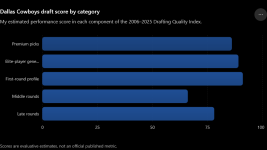
 
Ha, then I asked it to go in depth and show me it's math on Dallas' ranking at 4, here is what it gave:

Dallas is a fascinating case because the Cowboys are not equally strong in all five categories. Their top-five overall ranking comes primarily from two things:
  1. An unusually strong record with first-round picks, particularly from 2010 through 2022.
  2. Several enormous selections outside Round 1, most importantly Dak Prescott, DaRon Bland, DeMarcus Lawrence and Tony Pollard.
Their weakness is that the average Cowboys draft often becomes top-heavy: one premium success, perhaps one additional starter, and then several players who never become meaningful contributors.
I would score Dallas at approximately 81 out of 100, placing them around fourth in the league for the 2006–2025 period.

Dallas Cowboys draft score by category.png

Dallas’s weighted score​

CategoryWeightDallas scoreWeighted contribution
Premium-pick performance35%8630.1
Elite-player generation25%8922.3
First-round hit/bust profile20%9118.2
Middle-round roster building15%669.9
Late-round success5%783.9
Total100%84.4
That 84.4 is best understood as an elite drafting score, but not a complete drafting score. Green Bay and Baltimore would beat Dallas mainly through greater year-to-year depth and more dependable Day 2 and Day 3 production.

1. Premium-pick performance — 86/100​

Weight: 35%
Weighted value: 30.1 points

For this category, I am examining every selection in the first three rounds, with the strongest emphasis on exact draft position.
Dallas performs extremely well here because it repeatedly converts first-round picks in the teens and twenties into players who perform like top-ten selections.

The premium picks that drive Dallas’s score​

Exceptional surplus selections​

Dez Bryant, No. 24 in 2010
Bryant became a genuine No. 1 receiver, produced three consecutive seasons above 1,200 yards and made first-team All-Pro. Getting that level of player at No. 24 represents clear surplus value.
Tyron Smith, No. 9 in 2011
A top-ten selection is supposed to become an excellent starter, so merely being good would not generate enormous surplus. Smith exceeded even top-ten expectations: eight Pro Bowls, multiple All-Pro selections and more than a decade as one of football’s best tackles.
This is a major hit, although not as mathematically surprising as finding the same player at No. 25.
Travis Frederick, No. 31 in 2013
One of the best Dallas selections of the entire period. Frederick became an immediate starter, made five Pro Bowls and earned first-team All-Pro recognition.
Dallas was criticized on draft night for selecting him earlier than consensus projections. That does not matter in retrospective evaluation. The Cowboys identified a premium center near the end of Round 1 and received top-ten-caliber performance.
Zack Martin, No. 16 in 2014
Probably Dallas’s best first-round selection during this window when draft position is considered.
Martin became one of the greatest guards of his generation, earning first-team All-Pro recognition in seven seasons. He supplied Hall of Fame-level performance from the middle of Round 1.
DeMarcus Lawrence, No. 34 in 2014
Dallas traded up for Lawrence, so the capital cost was greater than the nominal No. 34 slot. Even accounting for that, Lawrence became a strong success: a long-term starter, productive edge defender and multiple-time Pro Bowler.
He was not consistently an elite sack producer, but Dallas received roughly a decade of high-quality defensive play from an early second-rounder.
Dak Prescott, No. 135 in 2016
Dak technically belongs to the middle-round category, but he also affects Dallas’s overall premium-value analysis because he solved the most valuable position in football without the use of premium capital.
In a complete portfolio evaluation, that allowed Dallas to direct first-round picks toward Elliott, Vander Esch, Lamb, Parsons and offensive linemen rather than repeatedly spending top picks chasing quarterbacks.
CeeDee Lamb, No. 17 in 2020
Lamb has already dramatically exceeded normal expectations for the 17th pick. He developed into a first-team All-Pro and one of the league’s most productive receivers.
The selection also illustrates an important Dallas strength: the Cowboys will sometimes ignore immediate roster hierarchy when a clearly superior player falls. They already had Amari Cooper and Michael Gallup, but took Lamb because his talent represented greater value than reaching for a need.
Micah Parsons, No. 12 in 2021
An enormous hit. Dallas traded down from No. 10, acquired additional capital and still selected Parsons at No. 12.
Parsons immediately became a first-team All-Pro and perennial Defensive Player of the Year candidate. Even at No. 12, that is massive surplus value.
Tyler Smith, No. 24 in 2022
Another selection criticized initially as a reach or project. Smith quickly became a high-level guard and earned All-Pro recognition.
Turning the 24th pick into a young All-Pro offensive lineman is exactly the type of outcome that drives Dallas’s premium-pick ranking.
Dallas’s published first-round history confirms that many of these players came well outside the very top of the round: Bryant at 24, Frederick at 31, Martin at 16, Jones at 27, Lamb at 17, Parsons at 12 and Tyler Smith at 24.

Solid premium picks that add value​

These were not necessarily transformational choices, but generally met or exceeded reasonable expectations.

Anthony Spencer, No. 26 in 2007​

Spencer was never a major star, but he became a productive long-term starter and had one Pro Bowl season. That is a satisfactory result at pick 26.

Mike Jenkins, No. 25 in 2008​

Jenkins made a Pro Bowl and started for several seasons. His peak was relatively brief, but he provided reasonable late-first-round value.

Sean Lee, No. 55 in 2010​

Lee was an outstanding linebacker when healthy and played at an All-Pro level.
The injuries prevent this from being an enormous surplus selection because Dallas received only three seasons in which Lee started at least 14 games. But the evaluation itself was excellent: Dallas found first-round ability late in Round 2.

DeMarco Murray, No. 71 in 2011​

An outstanding third-round selection. Murray became an All-Pro and led the NFL in rushing in 2014.
Dallas received only four seasons before allowing him to leave, but the drafting question is whether the team identified talent. It unquestionably did.

Byron Jones, No. 27 in 2015​

Jones developed into an excellent cornerback and made second-team All-Pro. He did not generate many interceptions, but coverage value matters more than raw turnover totals.
A high-level starter at No. 27 is a clear success.

Ezekiel Elliott, No. 4 in 2016​

Elliott is complicated.
As a player, he was an obvious hit:
  • Immediate first-team All-Pro
  • Two rushing titles
  • Multiple Pro Bowls
  • Central offensive player for several seasons
But the opportunity cost was substantial. A running back selected fourth must become exceptional merely to meet positional expectations, and Dallas passed on players at more valuable positions.
I still classify Elliott as a premium-pick hit but only modest surplus value. He was far too productive to call a mistake in pure drafting evaluation, but taking a running back fourth lowers the efficiency score compared with finding similar production later.

Trevon Diggs, No. 51 in 2020​

Diggs earned first-team All-Pro recognition after producing 11 interceptions in 2021. His gambling style can concede plays, and injuries have interrupted his career, but a second-round corner reaching that peak is an excellent outcome.

Sam Williams, No. 56 in 2022​

Williams flashed rotational pass-rush ability, but legal issues, injuries and limited availability prevented him from becoming a clean success. He represents approximately neutral-to-negative value relative to the slot.

Premium misses and disappointments​

Dallas’s score is excellent, not perfect.

Bobby Carpenter, No. 18 in 2006​

A clear first-round bust. Carpenter never became a regular defensive starter for Dallas and was traded after four seasons.

Felix Jones, No. 22 in 2008​

Jones was explosive and useful, but he never became a dependable feature player. At No. 22, his production was disappointing.
I would classify him as a marginal selection rather than a catastrophic bust.

Martellus Bennett, No. 61 in 2008​

Bennett eventually became a good NFL tight end, but most of his best production occurred after leaving Dallas. The talent identification deserves some credit, but the Cowboys received limited return.

The entire 2009 class​

Dallas had no first-round pick after trading for Roy Williams and did not select until No. 69. The class produced almost no meaningful long-term value.
Robert Brewster, Jason Williams, Stephen McGee, Victor Butler and Brandon Williams did not become core players. This was Dallas’s worst class of the period and substantially damages its middle-round score.

Morris Claiborne, No. 6 in 2012​

A major miss because Dallas traded up and spent the sixth pick.
Claiborne became a functional NFL corner but never approached the shutdown-player expectations attached to his draft position and trade cost. Injuries contributed, but outcome evaluation still treats this as a significant negative.

Gavin Escobar, No. 47 in 2013​

Escobar was a clear second-round miss. He never became a meaningful receiving threat or starting tight end.

Randy Gregory, No. 60 in 2015​

This is difficult to classify. The football evaluation was correct: Gregory possessed first-round pass-rush talent. But availability problems prevented Dallas from realizing normal second-round value.
I assign partial credit for talent identification but a negative outcome score.

Jaylon Smith, No. 34 in 2016​

Smith returned from a devastating knee injury and produced two good seasons, including a Pro Bowl appearance. But Dallas selected him knowing he might never fully recover, and his performance declined sharply after signing an extension.
He was not a bust in the usual sense. He was a volatile second-round gamble that produced a modest positive return but less than Dallas hoped.

Taco Charlton, No. 28 in 2017​

Dallas’s worst recent first-round selection. Charlton lasted only two seasons with the Cowboys and was released while T.J. Watt, selected two picks later, became one of the league’s premier defenders.
The presence of Watt does not by itself make Charlton worse statistically, but it makes the evaluation error especially obvious.

Trysten Hill, No. 58 in 2019​

A significant second-round miss. Hill never developed into a reliable starter or major rotational contributor.

Kelvin Joseph, No. 44 in 2021​

Another clear second-round miss. Joseph contributed primarily on special teams and was traded after two seasons.

Mazi Smith, No. 26 in 2023​

Through the presently available portion of his career, Smith has underperformed first-round expectations. However, I would not yet apply a full bust penalty because defensive tackles often develop slowly and his role and playing weight shifted between coaching staffs.

Tyler Guyton, No. 29 in 2024​

Still unresolved. His rookie and second-year results were too inconsistent to award strong positive value, but selecting a developmental tackle at No. 29 requires more than two seasons of evidence. Current reporting entering 2026 indicates Dallas still views him as its starting left tackle after technical improvement, though his first two seasons were affected by inconsistency and injuries.

Tyler Booker, No. 12 in 2025​

Too early to score firmly. His rookie performance can receive limited credit, but a guard selected 12th must ultimately become a very good player to generate substantial surplus value. Dallas’s official draft history lists Booker as the 2025 first-round selection at No. 12.

Premium-pick conclusion​

Dallas’s major strength is not simply that it finds good first-rounders. It is that it repeatedly finds elite players after the first ten picks.
That creates tremendous surplus:
  • Bryant at 24
  • Frederick at 31
  • Martin at 16
  • Byron Jones at 27
  • Lamb at 17
  • Parsons at 12
  • Tyler Smith at 24
The poor selections—Claiborne, Charlton, Escobar, Hill and Joseph—are real. But the positive results are more numerous, more productive and generally longer-lasting.
Category grade: A

2. Elite-player generation — 89/100​

Weight: 25%
Weighted value: 22.3 points

This category asks a different question:
Did Dallas merely find starters, or did it draft players who became among the best at their positions?
Dallas’s answer is emphatically yes.

Tier 1: Hall of Fame or plausible Hall of Fame-level careers​

Zack Martin​

Martin is the clearest example. Seven first-team All-Pro selections place him in historically elite company. He is not merely a great Dallas pick; he is one of the best selections by any NFL team during this period.

Tyron Smith​

Smith has a strong Hall of Fame case based on longevity, peak performance, eight Pro Bowls and multiple All-Pro seasons.

Travis Frederick​

Frederick played only seven seasons because of illness and early retirement, which probably prevents a Hall of Fame career. At his peak, however, he was one of football’s best centers.

Micah Parsons​

Parsons was tracking toward this tier almost immediately, although the final historical assessment depends on longevity and continued peak performance.

CeeDee Lamb​

Lamb has established himself as a genuine elite receiver, though he needs additional high-level seasons before receiving Hall of Fame-level treatment.
Dallas’s official team history identifies Prescott as its career passing leader through 2026, illustrating the scale of value Dallas received from a fourth-round quarterback.

Tier 2: Multiple-year elite or first-team All-Pro players​

  • Dez Bryant
  • DeMarco Murray
  • Ezekiel Elliott
  • Dak Prescott
  • Trevon Diggs
  • DaRon Bland
  • Sean Lee when healthy
  • Tyler Smith, with his career still developing
Bland is particularly valuable in this category because Dallas obtained a first-team All-Pro season and an NFL record for interception-return touchdowns from the 167th overall pick.

Tier 3: High-end long-term starters​

  • DeMarcus Lawrence
  • Byron Jones
  • Leighton Vander Esch at his early peak
  • Tony Pollard
  • Jake Ferguson potentially trending toward this tier
  • Osa Odighizuwa

Why Dallas is not at 95–100​

Dallas generated many elite players, but the distribution is heavily concentrated in:
  • Offensive line
  • Wide receiver
  • Linebacker/edge
  • Running back
Dallas has not drafted an elite safety during this window, has had inconsistent defensive-tackle returns and has not generated a truly elite traditional interior pass rusher.
The Cowboys also lack the sheer transcendent volume of a Baltimore or Kansas City portfolio that includes players such as Lamar Jackson, Travis Kelce, Patrick Mahomes or Chris Jones.
Most importantly, elite-player generation is not identical to championship construction. Dallas has produced enough stars to field excellent top-end rosters, but often lacked the depth to survive injuries or compensate for weaknesses elsewhere.
Category grade: A

3. First-round hit and bust profile — 91/100​

Weight: 20%
Weighted value: 18.2 points

This is Dallas’s strongest category.
Using the 2006–2025 first-round selections, I would classify them as follows.

Major hits​

  • Dez Bryant
  • Tyron Smith
  • Travis Frederick
  • Zack Martin
  • Byron Jones
  • Ezekiel Elliott
  • CeeDee Lamb
  • Micah Parsons
  • Tyler Smith
That is nine major hits.

Ordinary hits or acceptable selections​

  • Anthony Spencer
  • Mike Jenkins
  • Leighton Vander Esch
Vander Esch is challenging because neck injuries shortened his career. But he made second-team All-Pro as a rookie and was a good starter when healthy. The result was disappointing in longevity, not evaluation.

Marginal or below-expectation selections​

  • Felix Jones
  • Morris Claiborne
  • Mazi Smith, provisionally
  • Tyler Guyton, provisionally
Claiborne is substantially worse than merely marginal once the trade-up cost is included. But he did start for years and was not a total non-player.

Clear busts​

  • Bobby Carpenter
  • Taco Charlton
Potentially Mazi Smith could eventually join this group, but it is too early for a definitive classification.

No first-round selection​

Dallas had no first-round selection in:
  • 2009, because of the Roy Williams trade
  • 2019, because of the Amari Cooper trade
Those trades need separate treatment.

The 2009 first-round absence​

Trading premium capital for Roy Williams was a major roster-management failure. But because this model evaluates drafting rather than veteran trades, I would not score Dallas as though it drafted a nonexistent player.
I would apply a modest portfolio penalty because using a first-round pick on an unsuccessful veteran acquisition still removed the opportunity to draft.

The 2019 first-round absence​

The Amari Cooper trade was much more successful. Cooper immediately improved the offense and produced multiple strong seasons.
Again, that is not drafting success, but it should not be treated as a first-round bust either.
The Cowboys’ first-round list confirms how consistently their selections came late in the round rather than from repeated top-five access. From 2010 through 2024, only Elliott and Claiborne were selected inside the top ten; most of the remaining choices came between Nos. 12 and 31.

Dallas’s approximate first-round batting average​

Excluding the unresolved 2023–2025 selections:
  • Major hits: 9
  • Acceptable hits: 3
  • Marginal/disappointing: 2
  • Clear busts: 2
That means roughly 75% of Dallas’s settled first-rounders became at least credible multiyear starters, and well over half became Pro Bowl or All-Pro-level players.
That is extraordinary.
The average NFL team does not approach that rate. First-round selections still fail frequently, even after accounting for the higher expected value of those slots. Dallas’s relative avoidance of complete first-round failures is the strongest statistical argument for ranking it among the league’s best drafting organizations.

One important qualification​

Dallas has sometimes selected relatively “safe” positions in Round 1:
  • Offensive tackle
  • Guard
  • Center
  • Running back
  • Off-ball linebacker
That can increase the apparent hit rate because certain positions transition more predictably than quarterback, cornerback or edge rusher.
But Dallas deserves credit for understanding what it evaluates well. Drafting Zack Martin instead of chasing a riskier position is not gaming the model; it is good drafting.
Category grade: A+

4. Middle-round roster building — 66/100​

Weight: 15%
Weighted value: 9.9 points

This category covers rounds 2–5. It is where Dallas falls behind Green Bay, Baltimore and probably Pittsburgh.
Dallas has produced several spectacular middle-round selections, but it has not done so consistently enough.

Exceptional middle-round hits​

Sean Lee, Round 2​

First-round talent whose injuries caused him to fall. A superb player when healthy.

DeMarco Murray, Round 3​

An All-Pro and rushing champion at pick 71.

DeMarcus Lawrence, Round 2​

A decade-long defensive cornerstone.

Dak Prescott, Round 4​

The single most valuable Dallas pick of the period when position and acquisition cost are considered.
A fourth-round franchise quarterback is an organizational-altering selection.

Tony Pollard, Round 4​

Pollard developed from a change-of-pace player into a Pro Bowl-caliber starter and major explosive-play threat.

DaRon Bland, Round 5​

A first-team All-Pro and historic interception-return season from pick 167.
These six selections alone create enormous surplus.

Good middle-round starters and contributors​

Jason Hatcher, Round 3 in 2006​

Hatcher developed slowly but ultimately became a productive defensive lineman and Pro Bowler.

Stephen Bowen, effectively a late-round/undrafted-era contributor​

Not part of this drafted sample, but illustrative of Dallas’s defensive-line development during the earlier portion of the window.

Tyrone Crawford, Round 3 in 2012​

Crawford was never a star, but he became a versatile, long-serving defensive-line starter and useful rotation player.

Terrance Williams, Round 3 in 2013​

A respectable complementary receiver who started 67 games for Dallas and contributed to several good offenses.

Anthony Hitchens, Round 4 in 2014​

A four-year starter who later earned a significant free-agent contract. This is exactly what a successful fourth-round selection looks like.

Dalton Schultz, Round 4 in 2018​

Schultz developed into a productive starting tight end and later received a substantial contract from Houston.

Michael Gallup, Round 3 in 2018​

Before his knee injury, Gallup developed into a strong outside receiver and produced a 1,100-yard season.

Connor McGovern, Round 3 in 2019​

McGovern became a functional NFL starter, though much of his subsequent value came outside Dallas.

Osa Odighizuwa, Round 3 in 2021​

A strong selection who became a disruptive starting defensive tackle.

Jake Ferguson, Round 4 in 2022​

Ferguson quickly became a starting tight end and Pro Bowl-level receiving option.

Cooper Beebe, Round 3 in 2024​

Promising early return, but still too young for a definitive grade.

The middle-round misses are numerous​

The less flattering side includes:
  • James Marten, Round 3
  • Isaiah Stanback, Round 4
  • Akwasi Owusu-Ansah, Round 4
  • David Arkin, Round 4
  • Matt Johnson, Round 4
  • Gavin Escobar, Round 2
  • J.J. Wilcox, Round 3, although he did become a starter
  • Chaz Green, Round 3
  • Charles Tapper, Round 4
  • Ryan Switzer, Round 4
  • Trysten Hill, Round 2
  • Connor Williams, Round 2, a functional starter but penalty-prone in Dallas
  • Kelvin Joseph, Round 2
  • Jabril Cox, Round 4
  • Josh Ball, Round 4
  • Luke Schoonmaker, Round 2, thus far below expectations
  • Viliami Fehoko, Round 4, unresolved but limited early return
Dallas’s second-round record is especially volatile.

The second-round “risk pick” pattern​

The Cowboys have often used Round 2 to pursue players who fell because of injury, character or developmental concerns:
  • Sean Lee: injury history
  • Bruce Carter: knee injury
  • DeMarcus Lawrence: trade-up and projection
  • Randy Gregory: substance-policy concerns
  • Jaylon Smith: catastrophic knee injury
  • Sam Williams: character concerns
  • Kelvin Joseph: character concerns
This strategy produced some outstanding value, especially Lee and Lawrence. But it also produced too many players whose availability prevented Dallas from realizing their theoretical talent.
That is why I would not give Dallas an elite middle-round grade despite Dak, Bland and Murray.

What separates Dallas from Green Bay and Baltimore​

Dallas is capable of hitting a home run in rounds 2–5. It is less successful at producing the routine singles and doubles:
  • Third-round starting guard
  • Fourth-round rotational defensive end
  • Fifth-round reliable safety
  • Backup tackle who starts competently when needed
  • No. 3 corner who lasts through a second contract
Green Bay and Baltimore more regularly emerge from a draft with several such players.
Dallas more often produces:
one star + one potential contributor + four roster washouts.
That can build an impressive starting lineup, but not necessarily a deep 53-man roster.
Category grade: B−

5. Late-round success — 78/100​

Weight: 5%
Weighted value: 3.9 points

Rounds 6 and 7 are inherently low-probability territory, so Dallas should not be punished heavily for players who fail there.
Its score is elevated by several major successes.

Major late-round successes​

Jay Ratliff is outside this exact window​

Ratliff was selected in 2005, so he does not count in a strict 2006–2025 evaluation. Including him would improve Dallas’s reputation, but doing so would move the goalposts.

Nick Folk, Round 6 in 2007​

Folk became a Pro Bowl kicker for Dallas and has had an exceptionally long NFL career.
Kickers receive less positional value than premium starters, but a sixth-rounder lasting nearly two decades is still a strong selection.

Orlando Scandrick, Round 5 in 2008​

Technically a fifth-rounder and therefore part of the middle-round category. Scandrick played 125 games for Dallas and became an effective slot corner.

Dwayne Harris, Round 6 in 2011​

Harris became a valuable returner, special-teamer and reserve receiver. This is a highly successful sixth-round outcome.

James Hanna, Round 6 in 2012​

A useful blocking tight end and special-teams contributor for several years.

Anthony Brown, Round 6 in 2016​

One of Dallas’s best true late-round choices. Brown started 69 games and became a credible NFL corner.

Xavier Woods, Round 6 in 2017​

Woods became a multiyear starting safety for Dallas and continued starting elsewhere.

Cedrick Wilson, Round 6 in 2018​

A useful fourth receiver who eventually produced enough to earn a multiyear free-agent contract.

Donovan Wilson, Round 6 in 2019​

A genuine starting safety and physical defensive contributor.

Israel Mukuamu, Round 6 in 2021​

A useful reserve defensive back and special-teamer, although not a major hit. His later NFL role remained limited, and by 2026 he had played only 33 games for Dallas between 2021 and 2023.

Markquese Bell, undrafted​

Bell does not count because this is a draft-only model. Dallas has historically been very effective with undrafted free agents, but including them would materially change the question.

What Dallas does well late​

Dallas has found a recurring type of player in Round 6:
  • Defensive back with starting potential
  • Special-teams contributor
  • Reserve receiver
  • Blocking tight end
  • Kicker
That is meaningful.
The Cowboys do not have a Tom Brady-level seventh-round miracle, nor should that be expected. But Brown, Woods, Wilson, Harris and Folk collectively represent considerably better-than-average late-round return.

Why the score is not higher​

The seventh round itself has produced relatively little. Dallas’s meaningful late-round success has come more often in Round 6 than Round 7.
Dallas also tends to receive functional late-round value rather than superstar value. That is entirely acceptable, but it does not justify a 90-plus category score.
Category grade: B+

The best Dallas draft classes​

2014​

  • Zack Martin
  • DeMarcus Lawrence
  • Anthony Hitchens
  • Devin Street
  • Ben Gardner
  • Will Smith
  • Ahmad Dixon
  • Ken Bishop
  • Terrance Mitchell
Martin and Lawrence alone make this an exceptional class. Hitchens adds a starting linebacker. Three core starters, including one all-time great, is a tremendous result.

2016​

  • Ezekiel Elliott
  • Jaylon Smith
  • Maliek Collins
  • Charles Tapper
  • Dak Prescott
  • Anthony Brown
  • Kavon Frazier
  • Darius Jackson
  • Rico Gathers
This is probably Dallas’s deepest class.
It produced:
  • A rushing champion
  • A starting linebacker
  • A starting defensive tackle
  • A franchise quarterback
  • A starting corner
  • A useful special-teams safety
Dak at pick 135 makes the class historically valuable.

2020​

  • CeeDee Lamb
  • Trevon Diggs
  • Neville Gallimore
  • Reggie Robinson
  • Tyler Biadasz
  • Bradlee Anae
  • Ben DiNucci
Lamb and Diggs both became first-team All-Pros. Biadasz became a multiyear starting center. That is an outstanding three-player return.

2021​

  • Micah Parsons
  • Kelvin Joseph
  • Osa Odighizuwa
  • Chauncey Golston
  • Nahshon Wright
  • Jabril Cox
  • Josh Ball
  • Simi Fehoko
  • Quinton Bohanna
  • Israel Mukuamu
  • Matt Farniok
This class is more mixed than it initially appears.
Parsons is a superstar, Osa became a strong starter and Golston a useful rotational player. But Joseph, Wright, Cox and Ball were disappointing.
It is an excellent class because Parsons is so valuable, not because Dallas drafted well from top to bottom.

2022​

  • Tyler Smith
  • Sam Williams
  • Jalen Tolbert
  • Jake Ferguson
  • Matt Waletzko
  • DaRon Bland
  • Damone Clark
  • John Ridgeway
  • Devin Harper
This may be Dallas’s best balanced recent class:
  • All-Pro offensive lineman
  • Rotational pass rusher
  • Developing receiver
  • Starting tight end
  • All-Pro corner
  • Starting-capable linebacker
  • NFL defensive-line contributor
Even accounting for Williams’s problems, this is a remarkably productive group.

The worst Dallas draft classes​

2009​

The obvious worst class. Dallas had 12 selections and received almost no lasting value.
That class illustrates why pick quantity alone means little. Accumulating numerous mid- and late-round selections only helps when some become legitimate players.

2012​

  • Morris Claiborne
  • Tyrone Crawford
  • Kyle Wilber
  • Matt Johnson
  • Danny Coale
  • James Hanna
  • Caleb McSurdy
Crawford, Wilber and Hanna provided useful service, but trading up for Claiborne and failing to find an impact player makes this a poor class relative to the capital spent.

2017​

  • Taco Charlton
  • Chidobe Awuzie
  • Jourdan Lewis
  • Ryan Switzer
  • Xavier Woods
  • Marquez White
  • Joey Ivie
  • Noah Brown
  • Jordan Carrell
This is not actually a terrible complete class.
Awuzie, Lewis, Woods and Brown all became legitimate NFL players. The class is remembered negatively because Charlton was a first-round failure and T.J. Watt was available.
Under my model, Dallas receives a large first-round penalty but considerable middle/late-round credit.

2019​

  • Trysten Hill
  • Connor McGovern
  • Tony Pollard
  • Michael Jackson
  • Joe Jackson
  • Donovan Wilson
  • Mike Weber
  • Jalen Jelks
Pollard and Wilson save the class. Hill was a substantial miss, and most of the remaining players provided little.

What Dallas’s draft record says about the organization​

Dallas’s identifiable strengths​

1. Offensive-line evaluation​

Tyron Smith, Frederick, Martin and Tyler Smith constitute an extraordinary first-round record.
The organization appears particularly effective at identifying:
  • Athletic movement ability
  • Position flexibility
  • Competitive temperament
  • Whether college tackles can become elite NFL guards
  • Whether supposedly “unsexy” interior linemen justify first-round investment
This is Dallas’s clearest organizational scouting advantage.

2. Willingness to trust its board in Round 1​

Frederick, Martin, Lamb, Parsons and Tyler Smith were all selected amid some degree of debate:
  • Frederick was viewed as an overdraft.
  • Martin was selected instead of Johnny Manziel.
  • Lamb was not considered Dallas’s greatest immediate need.
  • Parsons had positional and character questions.
  • Tyler Smith was considered raw and penalty-prone.
Dallas was largely correct each time.

3. Wide-receiver evaluation near the top​

Bryant, Lamb and Gallup were excellent selections relative to their positions. Tolbert took longer to develop, and the Cowboys have fewer late-round receiver successes, but their premium receiver identification has been strong.

4. Finding defensive backs later than expected​

  • Anthony Brown
  • Xavier Woods
  • Donovan Wilson
  • DaRon Bland
  • Orlando Scandrick
  • Jourdan Lewis
Dallas has often found useful secondary players outside Round 1.

Dallas’s recurring weaknesses​

1. Second-round risk tolerance​

The Cowboys repeatedly attempt to recover first-round talent in Round 2 by accepting medical or character risk.
That produces spectacular upside but too much volatility.

2. Defensive-tackle evaluation​

Dallas has struggled to find high-impact defensive tackles:
  • Trysten Hill failed.
  • Maliek Collins was useful but not dominant.
  • Neville Gallimore did not become a major player.
  • Mazi Smith has underperformed thus far.
  • Osa Odighizuwa is the clear recent success.
The absence of a Chris Jones, Cameron Heyward, Fletcher Cox or Justin Madubuike-type interior defender is a major reason Dallas’s defense has sometimes been vulnerable despite excellent edge and linebacker talent.

3. Uneven depth production​

Dallas drafts stars better than it drafts complete rosters.
This sounds paradoxical, but it explains much of the franchise’s recent history. The Cowboys can field:
  • An elite guard
  • Elite receiver
  • Elite pass rusher
  • Good quarterback
  • Top corner
Yet still have conspicuous weaknesses at defensive tackle, safety, reserve offensive tackle or linebacker depth.

4. Occasional overconfidence in traits​

Selections such as Claiborne, Charlton, Kelvin Joseph and perhaps Mazi Smith reflect moments when Dallas’s projection did not translate cleanly into NFL performance.

My ultimate Dallas verdict​

Dallas’s drafting has been better than its postseason results have led most fans to believe.
The Cowboys’ lack of conference-championship appearances is not primarily because they have failed to identify high-end talent. A team does not accidentally draft:
  • Tyron Smith
  • Travis Frederick
  • Zack Martin
  • Dak Prescott
  • Ezekiel Elliott
  • CeeDee Lamb
  • Micah Parsons
  • Trevon Diggs
  • Tyler Smith
  • DaRon Bland
The greater organizational failures have occurred after or around the draft:
  • Incomplete roster supplementation
  • Weak free-agent activity in some years
  • Poor allocation of second contracts
  • Coaching and scheme instability
  • Insufficient depth
  • Playoff execution
  • Holding onto certain roster plans too long
From a pure drafting standpoint, I would summarize Dallas this way:
Elite in Round 1, excellent at generating stars, dangerous but inconsistent on Day 2, above average late, and less dependable at building complete classes than its reputation for individual selections suggests.
That profile justifies a ranking around fourth overall, while also explaining why I would place Green Bay and Baltimore above them. Dallas has drafted enough stars to contend repeatedly. Those other organizations have generally been better at surrounding their stars with a steady supply of inexpensive, competent players.
 
Been telling you guys for years we're one of the better drafting teams, which is why I always say our current situation is much better than it was during peak-Jerry nonsense.

But obviously there's still plenty missing.
 
I also asked it why we have had such little playoff success when every other team around us in the top 7 or so has won a Super Bowl and had way more playoff success than us.

It basically said the issue is Jerry's org structure. They are too inflexible compared to everyone else. The biggest issues are

1) refusal fill in gaps with trades and free agency like Philly and LA do
2) poor mid round drafting compared to teams like Green Bay (this compounds with #1, refusal to fill in gaps), leaves them top-heavy but with too many holes
3) poor coaching, situationally, at crunch time across the past few administrations (dating back to Wade)
4) waiting too long to extend players results in too many bad contracts and bad cap structure
5) And that yes, Dak specifically has choked and come up small in the playoffs, even more than Romo did before him.
 
Back
Top Bottom