- Joined
- Apr 7, 2013
- Messages
- 138,462
By Zak Keefer
Aug. 27, 2026 4:00 am CDT
PHOENIX — The call came in the fall of 1988, when he was a reservoir engineer fresh out of college, living in a one-bedroom apartment in Fort Smith, Ark. He spent his days behind the wheel of his Ford pickup, crisscrossing the South, charting oil reserves and piling up profits for his father’s company. The job fit.
“Probably my math mind,” he says.
If he looked hard enough, he could see the next 30 years. He liked that.
Football? He was convinced it was behind him, and he was fine with that. He’d lived his dream. He played at Arkansas, the quarterback recruit who ended up toiling on special teams, starting just one game — his last — and only then because the Razorbacks’ star safety was popped for steroids a few days before Oklahoma smacked them in the Orange Bowl.
A few months later, Dad called and said he wanted to buy the Dallas Cowboys.
“I know you’re starting to find your way in the oil business,” Jerry Jones told his son, “but what do you think about coming to Dallas and learning the football business with me?”
“I’ve already started my car,” Stephen Jones blurted out.
Tucked into a back booth at McArthur’s, the sleek restaurant that sits inside the Arizona Biltmore, the man who will one day run the most valuable sports franchise on the planet is telling the story of the day his life changed.
It’s a Sunday afternoon, late March. The NFL is in town for its annual meetings. Billionaires slip in and out, grabbing lunch before disappearing into conference rooms to debate rule proposals and replacement refs. Stephen Jones, in a white button-down with his collar open and his sleeves rolled back, is in no rush.
“Without that phone call,” he says, “I’d probably still be in the oil business.”
For a moment, the realization seems to surprise him. He never envisioned a different path. He never needed one. He takes a swig of Coke and unleashes a Texas-sized laugh so hearty it envelops half the restaurant. The implication is obvious.
For a 24-year-old, that’s a hell of a job offer.
Dad let him tag along for the first meeting, when Cowboys owner Bum Bright spilled his secret: America’s Team was losing $1 million a month. Within weeks, Bright dropped the price tag from $200 million to $140 million. Stephen held firm. He told his father it was too much.
“Dad’s a dealmaker. Everything he’s ever had his hands on he’s overpaid for,” he says. “I can be a little bit more tightfisted.”
Against his son’s hesitations — plus the advice of his own attorneys and accountants — Jerry put up every dollar he had to buy the team in February 1989, then borrowed the rest at sky-high interest rates. The gamble would come to define his life.
Ambition was innate to Jerry Jones, the need to climb and conquer and rewrite rules along the way. It made him an undeniable American life force, molder of the modern NFL, a man whose aspirations were matched only by his ego. Rarely does he enter a room and not devour the oxygen in it.
If that bothered his oldest son, Stephen never mentioned it. He learned early on he could let Jerry be Jerry and still stand on his own two feet — so long as those feet were a few steps out of frame. They’ve worked together for 37 years now, shoulder-to-shoulder but never quite equal, wrangling over contracts and draft picks and the price of their billion-dollar stadium while building the Cowboys into a commercial colossus. They’re also best friends, fierce loyalists and devoted drinking buddies who never paid much mind to the phrase “last call.”
Jerry and Gene Jones’ younger children are also Cowboys co-owners and executives — daughter Charlotte is chief brand officer and son Jerry Jr. chief sales and marketing officer — but it’s Stephen, 62, whom his father calls “my devil’s advocate” and “my barometer.” His official title: Chief Operating Officer, executive vice president of player personnel and president of AT&T Stadium.
Translation: He’s next.
Change is coming. The father relishes risk and the theater that comes with it. The son does not.
“I’m not pushing Jerry out by any means, but when that day comes, it’s gonna feel a lot different,” says Hall of Fame quarterback and Cowboys icon Troy Aikman.
Darren Woodson, another member of the team’s Ring of Honor, is more blunt: “Stephen’s going to chart a different path. He’s got a little bit more motherf—er in him.”
So much of Stephen’s climb is framed through his father. When he was growing up, Jerry would fly from Oklahoma City to Little Rock on weeknights just to coach his YMCA football team. When Stephen reached high school, Jerry rented office space across from the practice field to keep tabs on his progress. “How’d it go today?” Dad would ask each evening, not letting on that he’d spied every snap through a pair of binoculars.
Lessons came in the form of pacts. The dealmaker knew no other way. After Stephen was caught drinking at an eighth-grade school dance, Jerry drove him straight to Arkansas’ War Memorial Stadium. “So, you wanna be a college athlete?” he asked. Stephen nodded. “Then you can’t be a party boy.”
Next came the offer. Tell you what, Stephen, I’ll make a deal with you.
“Your job every day in the summer is to work out for football season,” Jerry told him. “Your ass better be outta the house by 8 a.m., and if I catch you back here before 2 …”
“So you can imagine the look on my dad’s face the next summer when he caught me having a few friends over to the pool one day,” Stephen says.
“Get your suit on!” Jerry barked. “You’ve got an interview.”
They drove in silence, pulled into a Wendy’s parking lot and walked in to meet the manager, who told Stephen he’d start by cleaning bathrooms, dishes and the grease trap before moving on to cooking burgers and fries.
“Can you be here tomorrow at 4 o’clock?” the manager asked.
Stephen nodded.
“Congratulations, you’ve got your first job,” Jerry told his son. “You fired up?”
They walked to the car in silence. Stephen hung his head. His father looked over and asked him if he remembered their deal.
“Yes, sir.”
“Well, I’ll tell you what. I told the manager you probably wouldn’t take the job this time, but one more f— up on your part and your ass is gonna be in here every day.”
Stephen exhaled.
“I made sure my ass wasn’t back in that house before 2 p.m. ever again!”
He grew into a star quarterback with grades good enough to get into Princeton. That’s where Jerry wanted him to go, and Stephen was all but sold during a campus tour after he heard a young actress named Brooke Shields would be in his freshman class.
Then Arkansas coach Lou Holtz called and offered a scholarship. Arkansas is where Jerry had played, co-captaining the 1964 national championship team as a sub-200-pound right guard, and where Gene had cradled Stephen in her arms on the sideline. It’s where he’d fallen for the game.
“All I’ve ever wanted to do is play ball for the Razorbacks,” he told his parents.
Tell you what, Stephen, I’ll make a deal with you.
“If you go to Arkansas,” Jerry said, “I want you taking the hardest curriculum the school has to offer.”
Stephen graduated as the Razorbacks’ only four-year letterwinner with a degree in chemical engineering. Jerry sneaked into the stadium to watch practices. He also learned something about his son he’d never forget: “If Stephen tells me he’s gonna do something, well, he’s gonna do it.”
Stephen ditched the oil business, moved to Dallas and heeded his father’s advice. He started from the bottom. He was a gofer, a sales rep, an understudy. He learned how to brand the Cowboys and how to sell the Cowboys. He learned to negotiate. “No one’s gonna care about our money like we will,” Jerry used to tell him. He’d fume when his father was criticized in the newspapers, which, back then, was all the time.
He became a buffer, smoothing over some of the tensions between Jerry and the first coach he brought to town. “I could work with Stephen Jones anytime,” Jimmy Johnson has said over the years. A decade later, Jerry brags, Bill Parcells would echo the sentiment.
In those early days Stephen found himself shadowing Mike McCoy, an old business partner whom Jerry had hired to work in the front office. Together they sketched out the Cowboys’ legendary trade value chart, which Johnson used to remake the roster and build a dynasty.
“Stephen got one of the best educations you can get in sports,” Jerry says. “He got a doctorate degree in the NFL.”
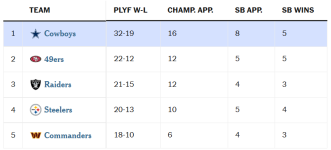
Most successful playoff teams, 1966-1996
As the championships piled up, the relationship changed. The son became the sidekick, the confidant, occasionally the foil. Start with spring 1995, when Stephen threw his father against a wall after the boss decided to sign free agent cornerback Deion Sanders to a $35 million deal despite Stephen’s strident salary-cap concerns.
“You really gonna do this?” Stephen shouted, shoving his arm into Jerry’s chest.
“What are you gonna do, hit me?” Jerry responded.
Temperatures cooled, and 10 months later Sanders helped Dallas win its third Super Bowl in four seasons. Jerry filed away another lesson: Stephen was never going to be a yes-man.
In the nervy moments before the Cowboys made their first-round pick in the 2014 NFL Draft, Stephen was the only one in the room with a strong enough spine to break the silence and talk his father out of taking Johnny Manziel, the talented but troubled quarterback out of Texas A&M. Dallas instead settled for an offensive guard.
“I hope you’re happy,” Stephen remembers his father telling him that night, face red, jaw clenched. “You don’t do special things in life — I would have never bought the Dallas Cowboys — making middle-of-the-road decisions. And what you just did is down the middle.
“You’ll never be great.”
Jerry apologized after the Cowboys turned in the pick, but the decision ate at him for months. The guard they drafted, Zack Martin, became a nine-time Pro Bowler and one of the best offensive linemen of his generation. Manziel washed out of the league in two years.
“There’s a belief that sometimes Stephen is part of the mistakes Jerry makes,” says Mike Rawlings, a Jones family friend, ex-business partner and former mayor of Dallas. “There’s also the belief that sometimes he saves Jerry’s ass.”
Sportico reported the franchise is now worth $15.5 billion. The Joneses are fabulously wealthy, the fanbase as restless as ever. The championship drought is 30 years long.
“How the hell does this keep happening?” Stephen grumbles at the table.
His father’s stubborn refusal to hire a typical general manager — Jerry keeps the title to himself — has made Stephen the franchise’s second-most influential voice, and as Jerry has scaled back in recent years, often the most influential. “Trust me, Stephen’s the guy,” Rawlings says.
With that comes a say in everything the organization does, and the blame that comes with years of disappointing playoff exits. “I wear it just like he wears it,” Stephen says of his father. “It’s been too damn long.”
Publicly, he keeps sidestepping questions about the future, about how he’ll run the team when his father is gone. The mere thought can bring Stephen to tears. But Jerry is 83. He already beat back cancer once. More and more it’s Stephen speaking for the franchise, Stephen directing the draft room, Stephen inching into the camera’s view.
“I don’t have a succession plan, I don’t,” Jerry insists, admitting that he’s already started to pass the baton. “One day I just won’t be here to toss my two cents in.”
The Jones family owns 207 million shares in Comstock Resources in part because of a visit Stephen made to a maximum-security prison in 1999.
Comstock CEO Jay Allison led a 34-year-old Stephen and other members of the Dallas chapter of the Young Presidents’ Organization on a tour of Gatesville Correctional Facility, including the O’Daniel Unit, which houses some of Texas’ death row inmates. Allison wanted them to get a measure of perspective. He says he can still remember the look on Stephen’s face.
“It was completely blank. He kept saying, ‘That was a life-changing event,'” Allison says. “It’s easy to forget how bad it can be and how fragile life is.”
A few weeks after the visit, Stephen reached back out. He knew Allison was bleeding cash due to plummeting oil prices and had an idea: “You should sit down with my dad.” They did. Allison asked for $30 million. Jerry mulled it over but declined. Allison ultimately found other backers, and that $30 million investment ballooned into $600 million in profits.
“Stephen might not be the gambler his father is,” Allison says, “but he can look at his dad and say, ‘I know a good opportunity when I see one.'”
Almost two decades later, the Joneses wanted to make a play in natural gas. Stephen brokered another meeting. The family decided to fold its $620 million outfit, Arkoma, into Comstock in exchange for 87 percent of the company. Within a year, Allison wanted to make a bet on exploration near the Gulf Coast. To do so, he needed to acquire another company, Covey Park Energy, for $2.2 billion. It required Jerry’s signoff — plus a $475 million check.
The gambler asked his son for advice. “You can trust Jay,” Stephen told his father. Jerry signed the check. Comstock now owns 806,980 acres across Texas and Louisiana’s shale footprint and produces more than 1 billion cubic feet of natural gas a day.
“Jerry has said publicly that his ownership in Comstock is equal to or even more valuable than the Cowboys,” Allison says. “None of that happens without Stephen being Stephen.”
For the son, the deal scratched an itch. It brought him back to those days in his Ford pickup, driving across Arkansas and Oklahoma and Texas, chasing the kinds of gushers that changed everything for his father. The difference: In those gushers, Jerry saw his ticket to the NFL. Stephen saw a math equation, profits on a page.
“Stephen,” his dad will tell him from time to time, “you’re just an engineer at heart.”
Allison knows both as well as any. He sees two types of leaders who’ve scripted two types of stories, men built different and wired different. That, he believes, could end up being a good thing for the Dallas Cowboys.
“What happened to Microsoft when Bill Gates stepped down? Or Apple when Steve Jobs stepped down?” Allison says. “Those companies didn’t fall apart. Matter of fact, they grew even more.”
The Cowboys’ rush of early success further emboldened Jerry Jones. Before long, he was waging war against the NFL itself and reimagining how it did business. The result? Fatter TV contracts, wealthier owners, glistening new stadiums. Jones’ own AT&T Stadium, the price tag for which Stephen bristled at back in 2009, has become a gold standard for American sporting venues.
In time, Jerry grew enamored by the show of it all, and his team became a reflection of its ringleader — the biggest and most profitable soap opera in sports. “It’s to a point where they can’t get a deal done without 30 days of ESPN talking head drama,” says longtime Dallas radio host Bob Sturm, who wrote for The Athletic from 2018 to 2023. “You almost wonder if they enjoy it.”
The approach has irked some former players. Woodson, whose commercial real estate firm rents office space at The Star, the Cowboys’ 91-acre practice facility that doubles as an exorbitant entertainment and business venture, puts it this way: “The team keeps making emotional decisions. They keep guys because Jerry likes them personally. I don’t think that leash will be as long with Stephen.”
Aikman sees it, too. “From my interactions with him, Stephen doesn’t have the ego his father has. That’ll serve him well.”
Aikman first met Stephen Jones the week of the 1989 NFL Draft. The Cowboys held the No. 1 pick. While his agent stayed back in Dallas to negotiate his rookie contract, Aikman flew to New York with Stephen on Jerry’s Learjet 35. They grabbed dinner and caught “The Phantom of the Opera” on Broadway. More than anything, the night eased any lingering worries Aikman had about joining a franchise with a rookie owner who was off to a stumbling start.
“Stephen’s just got this gift of making you feel like you’re the most important person he’s seen all day,” Aikman says.
The franchise under Stephen Jones, Aikman believes, will look and feel more like a typical NFL team, one where the owner doesn’t insist on playing the role of main character. “Stephen will be less inclined to want to get all the credit,” he says. “And I think he’ll create an environment conducive to winning.”
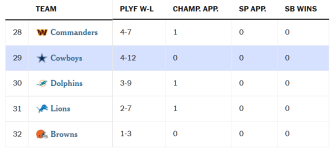
Least successful playoff teams, 1997-present
Had Stephen been in charge, Woodson believes, quarterback Dak Prescott and wideout CeeDee Lamb would’ve been extended months earlier than they were, saving the Cowboys tens of millions — but depriving them of months of headlines. Last year’s Micah Parsons trade? Woodson says the talented edge rusher would’ve been shipped out of town a lot sooner if Stephen were calling the shots.
“I guarantee you Stephen wanted that to be a dead issue, and dad let it ride,” Woodson says of the Parsons back-and-forth, which dragged on for months and ended with the Cowboys sending him to Green Bay last August for two first-round picks and tackle Kenny Clark. “I think the off-the-field stuff the organization had to deal with — showing up late, not being a team guy, paying a guy that kind of money when he’s not really a leader? Yeah, that s— ain’t flying.
“Jerry loves personalities, because Jerry is a personality,” Woodson continues. “I don’t think that’s Stephen’s deal.”
Stephen’s deal? Restraint. Rigidity. A weakness, he calls it, if he’s not careful.
“With agents these days, you give them an inch and they’ll take a mile,” Stephen says. He doesn’t like giving an inch, never has. “If a deal’s within striking distance, Jerry will lose this point and this point and this point and if it gets done, he’ll live with it. It’ll eat at me a little more.”
Critics of the Cowboys contend Stephen’s inflexibility has backfired in recent years as he’s assumed more control of the roster. Around the league, Dallas is known for being too stiff in contract negotiations; Jerry’s been accused of trying to bypass agents so he can deal directly with players, while Stephen is known for chasing bargains and tossing out lowball offers.
“Stephen seems to want to make sure there’s no secret who won the negotiation,” Sturm says. “And I do think that gets them in trouble, because that’s not how pro football works, or pro sports work … if you’re an owner with a great-win loss record in negotiations, that’s probably not good, because you’re upsetting your greatest assets.”
“I like to win every last point,” Stephen concedes. “I gotta watch that.”
What he excels at, those who’ve worked with him believe, is proficiency. Stephen’s smarts and savvy have earned him respect around the league, where for years he has served as co-chair of the NFL’s competition committee.
“He’s not just smart. His EQ is off the charts,” Rawlings says, referring to Jones’ emotional intelligence. “Stephen’s probably in the 99th percentile of understanding people and what drives them. Real leaders get others to follow when they’re not getting paid to follow. Stephen’s that sort of leader.”
Cowboys coach Brian Schottenheimer knows the perils of following in the footsteps of a famous NFL father — his dad, Marty, won 200 regular-season games over 21 seasons as the head coach of four teams. The shadow cast can be a long one. Escaping it isn’t easy.
“He’s different from his dad, in a good way,” Schottenheimer says. “He’s curious. He really digs into the people part of this. Stephen’s always asking me, ‘Why are you thinking this? How would this make us better?’ And he’s not afraid of having real conversations with Jerry. There is a level of respect there that makes this all work.”
“He’s his own man, and you could tell early on,” adds Norv Turner, the Cowboys’ offensive coordinator during the dynasty years. “Stephen’s never been afraid of that.”
Jerry has long had an irresistible urge to fight the current, to see if he was smarter than everyone else in the room. Early in life, he often was. Stephen never felt the need to prove himself in the same way. The urge instead was to lean on reason. If that made him cold and calculated, fine. Weighty decisions left no room for emotion.
“You can walk a pretty tight rope when you’ve got a net under you like Stephen,” Jerry says.
He admits his oldest son has reined him in on more occasions than he can count. He also admits he’s needed it.
“He’s about as good as anybody I’ve ever been around in giving deference when he should. Now, don’t confuse that with lack of intensity,” Jerry says. “He’ll bite back real hard when he has to. Real hard. He just does it with more grace than I do.”
In the era of private equity ownership, a handful of iconic families long associated with the franchises they’ve owned have started loosening their grip.
The Buss family, owners of the Los Angeles Lakers since 1979, sold controlling shares of the team last year. The family’s future involvement is very much in doubt after the team was subsequently sold to former Disney CEO Bob Iger and venture capitalist Josh Kushner earlier this month. The Las Vegas Raiders, long a reflection of late owner Al Davis, have sold off a handful of minority shares; while Davis’ son, Mark, remains majority owner, a succession plan is in place that will strip the family of control.
Could there be a day the Dallas Cowboys aren’t owned by the Joneses?
“We certainly don’t wanna think about that,” Stephen says flatly. “We don’t want it to be that way.”
The plan is in place and has been for years. One of the great regrets of Jerry’s life is not going to work with his father after college; as soon as he bought the Cowboys, he made certain his kids were close. All three own equal ownership shares and will collectively run the organization after Jerry is gone. But Stephen’s two cents will carry the most weight. It’ll be his team.
“They’ve been making decisions for the past 20, 30 years, and no doubt Stephen has been the leader of that group,” Jerry says. “For better or worse, we’ve been here as a team.”
Look closely in the Cowboys’ draft room, or on the sidelines before games, and you’ll see the future. John Stephen Jones started tagging along with his dad to training camp when he was 4 years old, hopping in cold tubs with the players and sneaking snacks from the lunch hall. In high school he wore a head of rugged brown hair, like he was straight off the set of “Friday Night Lights,” and led his team to a stirring comeback in the Texas 5A state title game. Jerry and Stephen both had tears in their eyes on the field at AT&T Stadium.
“Might’ve been better than winning the first two Super Bowls,” Stephen admits.
Advertisement
John Stephen is now 27 and the Cowboys’ manager of corporate partnerships, learning the football business from the ground up. “Getting his feet wet,” his dad says.
The team has won plenty since its last Super Bowl triumph in January 1996, just not in the playoffs, which is all that really matters for a franchise with five Lombardi Trophies enclosed in glass inside the entrance to its practice facility
“The drought,” Stephen calls it over lunch, shaking his head, growing a bit heated. “That’s what eats at us most. When that Super Bowl ends, all you think about it is, ‘Hey, we’re gonna win this sumbitch this year.'”
He’s already 15 years older than his father was when he bought the team in 1989. He won’t have the same imprint on the Cowboys or the league; on that front, few owners are in the same zip code as Jerry Jones.
But ending the drought would go a long way, and Stephen knows it.
Aug. 27, 2026 4:00 am CDT
PHOENIX — The call came in the fall of 1988, when he was a reservoir engineer fresh out of college, living in a one-bedroom apartment in Fort Smith, Ark. He spent his days behind the wheel of his Ford pickup, crisscrossing the South, charting oil reserves and piling up profits for his father’s company. The job fit.
“Probably my math mind,” he says.
If he looked hard enough, he could see the next 30 years. He liked that.
Football? He was convinced it was behind him, and he was fine with that. He’d lived his dream. He played at Arkansas, the quarterback recruit who ended up toiling on special teams, starting just one game — his last — and only then because the Razorbacks’ star safety was popped for steroids a few days before Oklahoma smacked them in the Orange Bowl.
A few months later, Dad called and said he wanted to buy the Dallas Cowboys.
“I know you’re starting to find your way in the oil business,” Jerry Jones told his son, “but what do you think about coming to Dallas and learning the football business with me?”
“I’ve already started my car,” Stephen Jones blurted out.
Tucked into a back booth at McArthur’s, the sleek restaurant that sits inside the Arizona Biltmore, the man who will one day run the most valuable sports franchise on the planet is telling the story of the day his life changed.
It’s a Sunday afternoon, late March. The NFL is in town for its annual meetings. Billionaires slip in and out, grabbing lunch before disappearing into conference rooms to debate rule proposals and replacement refs. Stephen Jones, in a white button-down with his collar open and his sleeves rolled back, is in no rush.
“Without that phone call,” he says, “I’d probably still be in the oil business.”
For a moment, the realization seems to surprise him. He never envisioned a different path. He never needed one. He takes a swig of Coke and unleashes a Texas-sized laugh so hearty it envelops half the restaurant. The implication is obvious.
For a 24-year-old, that’s a hell of a job offer.
Dad let him tag along for the first meeting, when Cowboys owner Bum Bright spilled his secret: America’s Team was losing $1 million a month. Within weeks, Bright dropped the price tag from $200 million to $140 million. Stephen held firm. He told his father it was too much.
“Dad’s a dealmaker. Everything he’s ever had his hands on he’s overpaid for,” he says. “I can be a little bit more tightfisted.”
Against his son’s hesitations — plus the advice of his own attorneys and accountants — Jerry put up every dollar he had to buy the team in February 1989, then borrowed the rest at sky-high interest rates. The gamble would come to define his life.
Ambition was innate to Jerry Jones, the need to climb and conquer and rewrite rules along the way. It made him an undeniable American life force, molder of the modern NFL, a man whose aspirations were matched only by his ego. Rarely does he enter a room and not devour the oxygen in it.
If that bothered his oldest son, Stephen never mentioned it. He learned early on he could let Jerry be Jerry and still stand on his own two feet — so long as those feet were a few steps out of frame. They’ve worked together for 37 years now, shoulder-to-shoulder but never quite equal, wrangling over contracts and draft picks and the price of their billion-dollar stadium while building the Cowboys into a commercial colossus. They’re also best friends, fierce loyalists and devoted drinking buddies who never paid much mind to the phrase “last call.”
Jerry and Gene Jones’ younger children are also Cowboys co-owners and executives — daughter Charlotte is chief brand officer and son Jerry Jr. chief sales and marketing officer — but it’s Stephen, 62, whom his father calls “my devil’s advocate” and “my barometer.” His official title: Chief Operating Officer, executive vice president of player personnel and president of AT&T Stadium.
Translation: He’s next.
Change is coming. The father relishes risk and the theater that comes with it. The son does not.
“I’m not pushing Jerry out by any means, but when that day comes, it’s gonna feel a lot different,” says Hall of Fame quarterback and Cowboys icon Troy Aikman.
Darren Woodson, another member of the team’s Ring of Honor, is more blunt: “Stephen’s going to chart a different path. He’s got a little bit more motherf—er in him.”
So much of Stephen’s climb is framed through his father. When he was growing up, Jerry would fly from Oklahoma City to Little Rock on weeknights just to coach his YMCA football team. When Stephen reached high school, Jerry rented office space across from the practice field to keep tabs on his progress. “How’d it go today?” Dad would ask each evening, not letting on that he’d spied every snap through a pair of binoculars.
Lessons came in the form of pacts. The dealmaker knew no other way. After Stephen was caught drinking at an eighth-grade school dance, Jerry drove him straight to Arkansas’ War Memorial Stadium. “So, you wanna be a college athlete?” he asked. Stephen nodded. “Then you can’t be a party boy.”
Next came the offer. Tell you what, Stephen, I’ll make a deal with you.
“Your job every day in the summer is to work out for football season,” Jerry told him. “Your ass better be outta the house by 8 a.m., and if I catch you back here before 2 …”
“So you can imagine the look on my dad’s face the next summer when he caught me having a few friends over to the pool one day,” Stephen says.
“Get your suit on!” Jerry barked. “You’ve got an interview.”
They drove in silence, pulled into a Wendy’s parking lot and walked in to meet the manager, who told Stephen he’d start by cleaning bathrooms, dishes and the grease trap before moving on to cooking burgers and fries.
“Can you be here tomorrow at 4 o’clock?” the manager asked.
Stephen nodded.
“Congratulations, you’ve got your first job,” Jerry told his son. “You fired up?”
They walked to the car in silence. Stephen hung his head. His father looked over and asked him if he remembered their deal.
“Yes, sir.”
“Well, I’ll tell you what. I told the manager you probably wouldn’t take the job this time, but one more f— up on your part and your ass is gonna be in here every day.”
Stephen exhaled.
“I made sure my ass wasn’t back in that house before 2 p.m. ever again!”
He grew into a star quarterback with grades good enough to get into Princeton. That’s where Jerry wanted him to go, and Stephen was all but sold during a campus tour after he heard a young actress named Brooke Shields would be in his freshman class.
Then Arkansas coach Lou Holtz called and offered a scholarship. Arkansas is where Jerry had played, co-captaining the 1964 national championship team as a sub-200-pound right guard, and where Gene had cradled Stephen in her arms on the sideline. It’s where he’d fallen for the game.
“All I’ve ever wanted to do is play ball for the Razorbacks,” he told his parents.
Tell you what, Stephen, I’ll make a deal with you.
“If you go to Arkansas,” Jerry said, “I want you taking the hardest curriculum the school has to offer.”
Stephen graduated as the Razorbacks’ only four-year letterwinner with a degree in chemical engineering. Jerry sneaked into the stadium to watch practices. He also learned something about his son he’d never forget: “If Stephen tells me he’s gonna do something, well, he’s gonna do it.”
Stephen ditched the oil business, moved to Dallas and heeded his father’s advice. He started from the bottom. He was a gofer, a sales rep, an understudy. He learned how to brand the Cowboys and how to sell the Cowboys. He learned to negotiate. “No one’s gonna care about our money like we will,” Jerry used to tell him. He’d fume when his father was criticized in the newspapers, which, back then, was all the time.
He became a buffer, smoothing over some of the tensions between Jerry and the first coach he brought to town. “I could work with Stephen Jones anytime,” Jimmy Johnson has said over the years. A decade later, Jerry brags, Bill Parcells would echo the sentiment.
In those early days Stephen found himself shadowing Mike McCoy, an old business partner whom Jerry had hired to work in the front office. Together they sketched out the Cowboys’ legendary trade value chart, which Johnson used to remake the roster and build a dynasty.
“Stephen got one of the best educations you can get in sports,” Jerry says. “He got a doctorate degree in the NFL.”
Most successful playoff teams, 1966-1996
As the championships piled up, the relationship changed. The son became the sidekick, the confidant, occasionally the foil. Start with spring 1995, when Stephen threw his father against a wall after the boss decided to sign free agent cornerback Deion Sanders to a $35 million deal despite Stephen’s strident salary-cap concerns.
“You really gonna do this?” Stephen shouted, shoving his arm into Jerry’s chest.
“What are you gonna do, hit me?” Jerry responded.
Temperatures cooled, and 10 months later Sanders helped Dallas win its third Super Bowl in four seasons. Jerry filed away another lesson: Stephen was never going to be a yes-man.
In the nervy moments before the Cowboys made their first-round pick in the 2014 NFL Draft, Stephen was the only one in the room with a strong enough spine to break the silence and talk his father out of taking Johnny Manziel, the talented but troubled quarterback out of Texas A&M. Dallas instead settled for an offensive guard.
“I hope you’re happy,” Stephen remembers his father telling him that night, face red, jaw clenched. “You don’t do special things in life — I would have never bought the Dallas Cowboys — making middle-of-the-road decisions. And what you just did is down the middle.
“You’ll never be great.”
Jerry apologized after the Cowboys turned in the pick, but the decision ate at him for months. The guard they drafted, Zack Martin, became a nine-time Pro Bowler and one of the best offensive linemen of his generation. Manziel washed out of the league in two years.
“There’s a belief that sometimes Stephen is part of the mistakes Jerry makes,” says Mike Rawlings, a Jones family friend, ex-business partner and former mayor of Dallas. “There’s also the belief that sometimes he saves Jerry’s ass.”
Sportico reported the franchise is now worth $15.5 billion. The Joneses are fabulously wealthy, the fanbase as restless as ever. The championship drought is 30 years long.
“How the hell does this keep happening?” Stephen grumbles at the table.
His father’s stubborn refusal to hire a typical general manager — Jerry keeps the title to himself — has made Stephen the franchise’s second-most influential voice, and as Jerry has scaled back in recent years, often the most influential. “Trust me, Stephen’s the guy,” Rawlings says.
With that comes a say in everything the organization does, and the blame that comes with years of disappointing playoff exits. “I wear it just like he wears it,” Stephen says of his father. “It’s been too damn long.”
Publicly, he keeps sidestepping questions about the future, about how he’ll run the team when his father is gone. The mere thought can bring Stephen to tears. But Jerry is 83. He already beat back cancer once. More and more it’s Stephen speaking for the franchise, Stephen directing the draft room, Stephen inching into the camera’s view.
“I don’t have a succession plan, I don’t,” Jerry insists, admitting that he’s already started to pass the baton. “One day I just won’t be here to toss my two cents in.”
The Jones family owns 207 million shares in Comstock Resources in part because of a visit Stephen made to a maximum-security prison in 1999.
Comstock CEO Jay Allison led a 34-year-old Stephen and other members of the Dallas chapter of the Young Presidents’ Organization on a tour of Gatesville Correctional Facility, including the O’Daniel Unit, which houses some of Texas’ death row inmates. Allison wanted them to get a measure of perspective. He says he can still remember the look on Stephen’s face.
“It was completely blank. He kept saying, ‘That was a life-changing event,'” Allison says. “It’s easy to forget how bad it can be and how fragile life is.”
A few weeks after the visit, Stephen reached back out. He knew Allison was bleeding cash due to plummeting oil prices and had an idea: “You should sit down with my dad.” They did. Allison asked for $30 million. Jerry mulled it over but declined. Allison ultimately found other backers, and that $30 million investment ballooned into $600 million in profits.
“Stephen might not be the gambler his father is,” Allison says, “but he can look at his dad and say, ‘I know a good opportunity when I see one.'”
Almost two decades later, the Joneses wanted to make a play in natural gas. Stephen brokered another meeting. The family decided to fold its $620 million outfit, Arkoma, into Comstock in exchange for 87 percent of the company. Within a year, Allison wanted to make a bet on exploration near the Gulf Coast. To do so, he needed to acquire another company, Covey Park Energy, for $2.2 billion. It required Jerry’s signoff — plus a $475 million check.
The gambler asked his son for advice. “You can trust Jay,” Stephen told his father. Jerry signed the check. Comstock now owns 806,980 acres across Texas and Louisiana’s shale footprint and produces more than 1 billion cubic feet of natural gas a day.
“Jerry has said publicly that his ownership in Comstock is equal to or even more valuable than the Cowboys,” Allison says. “None of that happens without Stephen being Stephen.”
For the son, the deal scratched an itch. It brought him back to those days in his Ford pickup, driving across Arkansas and Oklahoma and Texas, chasing the kinds of gushers that changed everything for his father. The difference: In those gushers, Jerry saw his ticket to the NFL. Stephen saw a math equation, profits on a page.
“Stephen,” his dad will tell him from time to time, “you’re just an engineer at heart.”
Allison knows both as well as any. He sees two types of leaders who’ve scripted two types of stories, men built different and wired different. That, he believes, could end up being a good thing for the Dallas Cowboys.
“What happened to Microsoft when Bill Gates stepped down? Or Apple when Steve Jobs stepped down?” Allison says. “Those companies didn’t fall apart. Matter of fact, they grew even more.”
The Cowboys’ rush of early success further emboldened Jerry Jones. Before long, he was waging war against the NFL itself and reimagining how it did business. The result? Fatter TV contracts, wealthier owners, glistening new stadiums. Jones’ own AT&T Stadium, the price tag for which Stephen bristled at back in 2009, has become a gold standard for American sporting venues.
In time, Jerry grew enamored by the show of it all, and his team became a reflection of its ringleader — the biggest and most profitable soap opera in sports. “It’s to a point where they can’t get a deal done without 30 days of ESPN talking head drama,” says longtime Dallas radio host Bob Sturm, who wrote for The Athletic from 2018 to 2023. “You almost wonder if they enjoy it.”
The approach has irked some former players. Woodson, whose commercial real estate firm rents office space at The Star, the Cowboys’ 91-acre practice facility that doubles as an exorbitant entertainment and business venture, puts it this way: “The team keeps making emotional decisions. They keep guys because Jerry likes them personally. I don’t think that leash will be as long with Stephen.”
Aikman sees it, too. “From my interactions with him, Stephen doesn’t have the ego his father has. That’ll serve him well.”
Aikman first met Stephen Jones the week of the 1989 NFL Draft. The Cowboys held the No. 1 pick. While his agent stayed back in Dallas to negotiate his rookie contract, Aikman flew to New York with Stephen on Jerry’s Learjet 35. They grabbed dinner and caught “The Phantom of the Opera” on Broadway. More than anything, the night eased any lingering worries Aikman had about joining a franchise with a rookie owner who was off to a stumbling start.
“Stephen’s just got this gift of making you feel like you’re the most important person he’s seen all day,” Aikman says.
The franchise under Stephen Jones, Aikman believes, will look and feel more like a typical NFL team, one where the owner doesn’t insist on playing the role of main character. “Stephen will be less inclined to want to get all the credit,” he says. “And I think he’ll create an environment conducive to winning.”
Least successful playoff teams, 1997-present
Had Stephen been in charge, Woodson believes, quarterback Dak Prescott and wideout CeeDee Lamb would’ve been extended months earlier than they were, saving the Cowboys tens of millions — but depriving them of months of headlines. Last year’s Micah Parsons trade? Woodson says the talented edge rusher would’ve been shipped out of town a lot sooner if Stephen were calling the shots.
“I guarantee you Stephen wanted that to be a dead issue, and dad let it ride,” Woodson says of the Parsons back-and-forth, which dragged on for months and ended with the Cowboys sending him to Green Bay last August for two first-round picks and tackle Kenny Clark. “I think the off-the-field stuff the organization had to deal with — showing up late, not being a team guy, paying a guy that kind of money when he’s not really a leader? Yeah, that s— ain’t flying.
“Jerry loves personalities, because Jerry is a personality,” Woodson continues. “I don’t think that’s Stephen’s deal.”
Stephen’s deal? Restraint. Rigidity. A weakness, he calls it, if he’s not careful.
“With agents these days, you give them an inch and they’ll take a mile,” Stephen says. He doesn’t like giving an inch, never has. “If a deal’s within striking distance, Jerry will lose this point and this point and this point and if it gets done, he’ll live with it. It’ll eat at me a little more.”
Critics of the Cowboys contend Stephen’s inflexibility has backfired in recent years as he’s assumed more control of the roster. Around the league, Dallas is known for being too stiff in contract negotiations; Jerry’s been accused of trying to bypass agents so he can deal directly with players, while Stephen is known for chasing bargains and tossing out lowball offers.
“Stephen seems to want to make sure there’s no secret who won the negotiation,” Sturm says. “And I do think that gets them in trouble, because that’s not how pro football works, or pro sports work … if you’re an owner with a great-win loss record in negotiations, that’s probably not good, because you’re upsetting your greatest assets.”
“I like to win every last point,” Stephen concedes. “I gotta watch that.”
What he excels at, those who’ve worked with him believe, is proficiency. Stephen’s smarts and savvy have earned him respect around the league, where for years he has served as co-chair of the NFL’s competition committee.
“He’s not just smart. His EQ is off the charts,” Rawlings says, referring to Jones’ emotional intelligence. “Stephen’s probably in the 99th percentile of understanding people and what drives them. Real leaders get others to follow when they’re not getting paid to follow. Stephen’s that sort of leader.”
Cowboys coach Brian Schottenheimer knows the perils of following in the footsteps of a famous NFL father — his dad, Marty, won 200 regular-season games over 21 seasons as the head coach of four teams. The shadow cast can be a long one. Escaping it isn’t easy.
“He’s different from his dad, in a good way,” Schottenheimer says. “He’s curious. He really digs into the people part of this. Stephen’s always asking me, ‘Why are you thinking this? How would this make us better?’ And he’s not afraid of having real conversations with Jerry. There is a level of respect there that makes this all work.”
“He’s his own man, and you could tell early on,” adds Norv Turner, the Cowboys’ offensive coordinator during the dynasty years. “Stephen’s never been afraid of that.”
Jerry has long had an irresistible urge to fight the current, to see if he was smarter than everyone else in the room. Early in life, he often was. Stephen never felt the need to prove himself in the same way. The urge instead was to lean on reason. If that made him cold and calculated, fine. Weighty decisions left no room for emotion.
“You can walk a pretty tight rope when you’ve got a net under you like Stephen,” Jerry says.
He admits his oldest son has reined him in on more occasions than he can count. He also admits he’s needed it.
“He’s about as good as anybody I’ve ever been around in giving deference when he should. Now, don’t confuse that with lack of intensity,” Jerry says. “He’ll bite back real hard when he has to. Real hard. He just does it with more grace than I do.”
In the era of private equity ownership, a handful of iconic families long associated with the franchises they’ve owned have started loosening their grip.
The Buss family, owners of the Los Angeles Lakers since 1979, sold controlling shares of the team last year. The family’s future involvement is very much in doubt after the team was subsequently sold to former Disney CEO Bob Iger and venture capitalist Josh Kushner earlier this month. The Las Vegas Raiders, long a reflection of late owner Al Davis, have sold off a handful of minority shares; while Davis’ son, Mark, remains majority owner, a succession plan is in place that will strip the family of control.
Could there be a day the Dallas Cowboys aren’t owned by the Joneses?
“We certainly don’t wanna think about that,” Stephen says flatly. “We don’t want it to be that way.”
The plan is in place and has been for years. One of the great regrets of Jerry’s life is not going to work with his father after college; as soon as he bought the Cowboys, he made certain his kids were close. All three own equal ownership shares and will collectively run the organization after Jerry is gone. But Stephen’s two cents will carry the most weight. It’ll be his team.
“They’ve been making decisions for the past 20, 30 years, and no doubt Stephen has been the leader of that group,” Jerry says. “For better or worse, we’ve been here as a team.”
Look closely in the Cowboys’ draft room, or on the sidelines before games, and you’ll see the future. John Stephen Jones started tagging along with his dad to training camp when he was 4 years old, hopping in cold tubs with the players and sneaking snacks from the lunch hall. In high school he wore a head of rugged brown hair, like he was straight off the set of “Friday Night Lights,” and led his team to a stirring comeback in the Texas 5A state title game. Jerry and Stephen both had tears in their eyes on the field at AT&T Stadium.
“Might’ve been better than winning the first two Super Bowls,” Stephen admits.
Advertisement
John Stephen is now 27 and the Cowboys’ manager of corporate partnerships, learning the football business from the ground up. “Getting his feet wet,” his dad says.
The team has won plenty since its last Super Bowl triumph in January 1996, just not in the playoffs, which is all that really matters for a franchise with five Lombardi Trophies enclosed in glass inside the entrance to its practice facility
“The drought,” Stephen calls it over lunch, shaking his head, growing a bit heated. “That’s what eats at us most. When that Super Bowl ends, all you think about it is, ‘Hey, we’re gonna win this sumbitch this year.'”
He’s already 15 years older than his father was when he bought the team in 1989. He won’t have the same imprint on the Cowboys or the league; on that front, few owners are in the same zip code as Jerry Jones.
But ending the drought would go a long way, and Stephen knows it.